



Every residential aged care home has to deliver a set number of direct care minutes per resident, per day.
Since 2026, that figure carries a funding, Star Rating and audit consequence, so more providers are looking at care minutes software to help track it.
Here's what good care minutes reporting software should help you do, whichever option you're looking at.
Does the software track your home's own target, not a sector average?
Every home has its own case-mix-adjusted target for total and RN care minutes, recalculated each quarter under the AN-ACC funding model.
While the sector-wide average (commonly quoted as 215 total minutes, including 44 RN minutes) gives providers a reference point, a dashboard built around an average won't tell you whether your specific home is on track.
Check the following when looking at care minutes reporting software:
- Does the software calculate against your home's own published target or the industry average?
- Does it separate total and RN minutes, since both are tracked and reported individually?
- Does it update as your resident mix changes (since this is how it’s calculated)?
If you want the detail behind how your care minutes target is calculated, we've covered it in our guide to care minutes.
Does the software connect to the systems you already use?
When you're comparing care minutes software, check whether it connects to the systems your team already uses, or whether it still relies on manual data entry.
Manual entry is where data consistency often emerges, especially when you're reconciling more than one home.
Good care minutes software should pull data directly from the source:
- Worked minutes from your rostering or payroll platform
- Resident and classification data directly from government services
- No spreadsheet sitting in the middle, translating one into the other
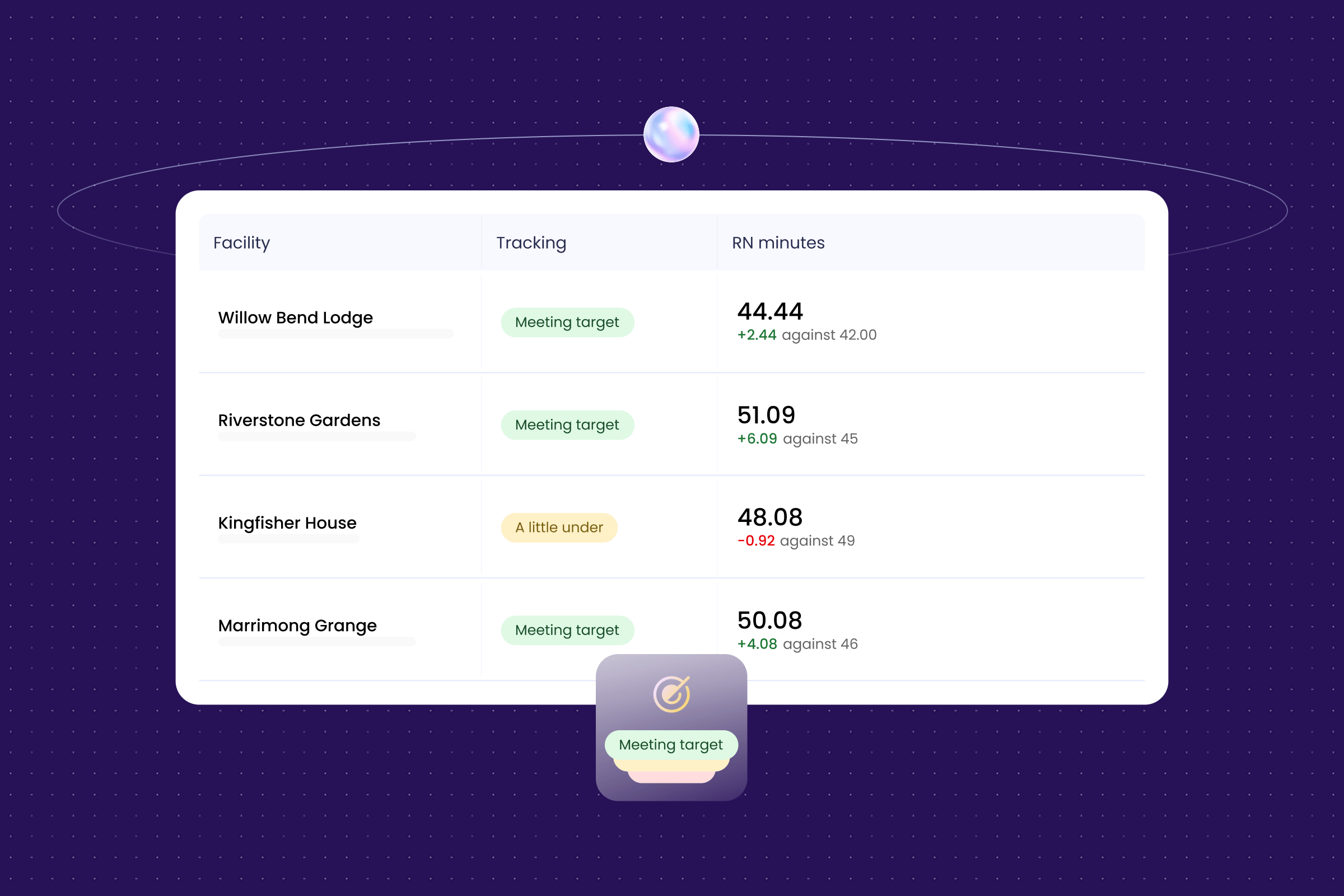
Can your care minutes reporting flag a problem before the quarter closes?
Most providers find out they're behind target only after the reporting quarter ends, when there's no longer an opportunity to address it.
That's because quarterly or monthly reporting can hide the daily shortfalls that add up over three months.
Look for care minutes reporting software that gives you:
- A daily, not monthly, view of delivered minutes against your target
- Enough lead time in the quarter to adjust a roster, not just explain a result
- The same live view for both total and RN coverage, in one place
A live, day-by-day view is what turns care minutes reporting from a quarterly scramble into something you can act on while it still matters.
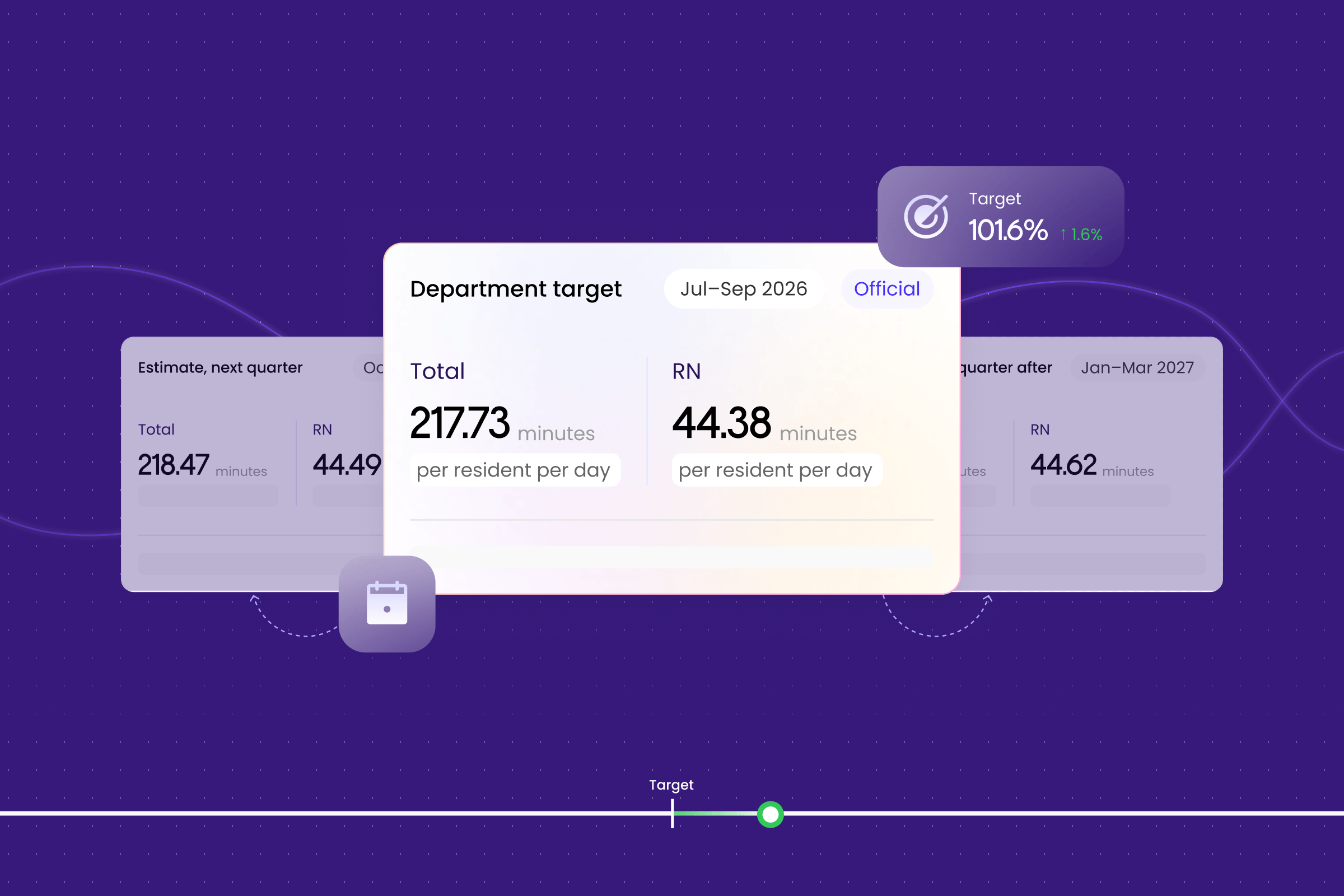
Does it help you prepare for the quarter ahead?
Each quarter's target is calculated by the government from residents who were already in the facility months earlier, so the data behind your facility's next target already exists today.
Software that runs the same government calculation can show you an estimated target for the next quarter before the Department publishes the official one. Just make sure it clearly labels which figure is the software’s estimate and which is your home's official, government-published target – you’re judged on the latter.
Is missing data in your care minutes reporting shown honestly?
Some systems fill a gap with a zero or an assumption, which can make a home look short when it isn't, or hide a real shortfall.
Be sure to ask software vendors what happens when a payroll feed is late or a government data file doesn't arrive on time.
Reliable care minutes software should:
- Show missing data as missing, rather than substitute a zero
- Flag gaps clearly rather than smoothing over them
- Let you see exactly which days or shifts a figure is built from
Will your aged care software hold up if someone has to check the figures?
From the 2025-26 Aged Care Financial Report, Care Minutes Performance Statements face external audit, which means every figure needs a source behind it.
Software that traces reported figures back to the shift, the role and the date gives providers a stronger position if their reporting is ever questioned.
Good care minutes software should keep that trail as a by-product of daily tracking:
- Every figure linked to its source data
- A record that exists from the day the care actually happened, rather than reconstructed afterwards
That trail is what the Aged Care Quality and Safety Commission will expect to see if a home is ever asked to demonstrate how it reached the numbers reported.
Choosing care minutes software that’s built to last
In the new era of care minutes, the margin for guesswork is shrinking while the complexity of reporting is growing.
Loop IQ’s care minutes software helps providers get on top of this requirement alongside recent and any future changes to legislation, with direct connection to your workforce system and Services Australia for data quality your team can rely on.
If you’re interested to see it in action, book a demo or contact our team – we’d love to give you a walkthrough.


